MANILA, Philippines - The Comedy King is dead. Long live the Comedy King!
It was curtain call for Dolphy who died at 8:34 last night at the ICU of the Makati Medical Center (MCC), where he was confined for more than three weeks for pneumonia.
He would have turned 84 on July 25.
Dr. Jake Marte, assistant patient relations officer of MMC, said, “Mr. Rodolfo ‘Dolphy’ Quizon passed away due to multiple organ failure brought about by severe pneumonia, chronic obstructive pulmonary disease and acute renal failure.”
He died surrounded by members of his family, some of whom had just arrived from abroad.
Dolphy is survived by 18 children and Zsa Zsa Padilla, whom he described as “the last woman in my life.” He had wanted very much to marry her but failed due to legal impediments. He died a bachelor.
Even if he was not conferred the honor as National Artist, notwithstanding his great contribution to the entertainment industry, Dolphy left behind a legacy of laughter that has influenced generations of Filipinos during a colorful career that spanned more than half a century and that covered the stage, radio, television and film.
Since two years ago when news about his illness was first reported, Dolphy had been in and out of the hospital due to recurrent pneumonia that struck him for the 12th time while he was at the Makati Med ICU. Years ago, he underwent a quadruple heart bypass.
Every now and then, rumors would spread that he had died, which he took with his characteristic sense of humor, saying he should not be rushed: “Bakit n’yo ako inaapura? Darating din ako d’yan. Huwag n’yo akong apurahin.”
A sadness would appear across his face when, during interviews, names of his contemporaries such as his teammate Panchito, Chiquito and other comedians were mentioned. “Wala na silang lahat; ako na lang ang natirira (They’re all gone; I’m the only one left).”
He often repeated the line, “Mamatay man ako at mabuhay muli, mag-aartista pa rin ako (Even if I die and live again, I will still be an actor.)”
His exposure to show biz began inside a theater where he sold peanuts and watermelon seeds.
He was 13 when World War II broke out. He helped the family make ends meet by doing odd jobs like shining shoes, attaching buttons at a pants factory, stevedoring at the pier and driving a horse-drawn buggy. He passed his free time watching his idols Pugo and Togo (for comedy) and Benny Mack and Bayani Casimiro (for dance) in stage shows at the Life Theater and Avenue Theater, both of which have been demolished.
He started as a stage performer during the Japanese occupation when Benny Mack got him as a chorus dancer, alternating between Life and Avenue, using the stage name Golay, later changed to Dolphy.
At 19, he did his first movie, “Dugo At Bayan (I Remember Bataan),” with Fernando Poe Sr., who first gave Dolphy breaks as a character actor.
In the late 1940s, Dolphy ventured into radio with the help of Conde Ubaldo, a popular radio writer, joining Pacho Magalona, Tessie Quintana and Baby Jane. It was Pancho, father of the late Francis Magalona, who recommended Dolphy to Starmaker Dr. Jose R. Perez of Sampaguita Pictures where Dolphy was groomed as a comedian initially playing gay characters (“Jack en Jill,” etc.) that he continued to portray in movies that he produced under his own company RVQ Productions, including such classics as “Facifica Falayfay,” “Fefita Fofonggay” and “Karioka Etchos de Amerika.”
But he would bag as FAMAS Best Actor not for a gay character but for a dual role depicting good and evil in “Omeng Satanasia.”
He is best remembered for the long-running TV show “Buhay Artista” (with Panchito) and “John en Marsha” with Nida Blanca as his with in an inspiring story about a poor yet happy family. The TV show was made into movies, just like “Home Along da Riles,” the show that followed it.
Dolphy was the only actor who won both Best Actor and Best Actress awards at the Brussels International Film Festival for playing a comfort gay in “Markova” in which he appeared with his sons Eric and Epi. Two years ago, he won Best Supporting Actor for a relatively brief role in “Rosario” at the Manila Filmfest. His last movie was “Father Jejemon,” also shown at a Manila Filmfest, which stirred a minor controversy because of a communion scene that the church found offensive.
“I’m a devout Catholic and I will never do anything that will displease the church,” said Dolphy who decided to remove that scene.
When he turned 80, Dolphy had his biography released, titled “Hindi Ko Ito Narating Mag-isa,” written by Bibeth Orteza, coinciding with the launch of the Dolphy Aid Para sa Pinoy Foundation, Inc., a non-profit and non-stock organization .
In one of his last long interviews with The STAR two years ago, done at his home while he attached to an oxygen tank, Dolphy said when asked what he was proud of as an actor, “I’m proud of what I have achieved. Palagay ko maski mamatay ako at nabuhay uli, I will still love to be an actor. My life as an actor is full of happiness. Ang dami ko na ring awards.”
And aside from making people laugh, what did he think was the best legacy that he would be leaving behind?
“Kapag naaalala ko kung tumatawa ang tao, masaya na ako,” he smiled.
Thank you, Dolphy, for making us laugh!
Source: Funfare by Ricky Lo
http://www.philstar.com/funfare/article.aspx?articleid=826305&publicationsubcategoryid=63
“I would highly appreciate very much if you would at least acknowledge any materials used or at least ask for a permission first. Unless specified, all other materials are from the private collection of the blog owner. Thank you very much!”
Wednesday, July 11, 2012
DOLPHY, 83
Wednesday, June 27, 2012
DIREK MARIO O'HARA, 66
According to his brother Jerry, O’Hara’s heart attack was a complication of his acute leukemia, which was diagnosed only this month. “My brother’s cardiologist already warned me that his low hemoglobin count could lead to this,” Jerry told the Inquirer in a phone interview. “He had been conscious. He still looked healthy despite his illness. His heart simply gave up.”
O’Hara’s remains lie at the Saint Alphonsus Mary Ligouri Parish on Magallanes Avenue in Makati City. Interment will be announced later.
Jerry said O’Hara been in and out of the hospital for two months. He was first brought there in May due to pneumonia. “This triggered a mild heart attack. He had been confined for three weeks,” he said in an interview on June 20.
O’Hara went home for a week, until his his condition “got worse” and had to be taken back to the hospital. “He felt weak. He lost his appetite and the small amount of food he ate, he vomited,” Jerry recalled. It was around this time that O’Hara’s leukemia had been diagnosed. “His body rejected medicine. His creatinine level shot up. This caused damage to his kidneys and liver,” the brother related. “Doctors also said his potassium level was high and that this could cause for his heart to stop any time.”
O’Hara underwent his first chemotherapy session on June 20. The following day, Jerry sent this message to the Inquirer: “He is responding very well to chemo.”
Jerry said O’Hara had initially refused cancer treatment and suffered from bouts of depression. “His doctors had told him, ‘give medicine a chance to work on you,’ but my brother replied, ‘doon (death) din naman ang uwi ko.’ He had bouts of depression. His family tried to encourage him, to keep him fighting.”
On Tuesday, Jerry said: “My brother fought for his life. He stood his ground. He even managed to fight his depression. We made some of his closest friends visit him to cheer him up. The day before he died, he even ate a big serving of his favorite sapin-sapin.”
O’Hara was a native of Zamboanga. He collaborated with the late National Artist for Film Lino Brocka in the 1970s in films such as “Insiang” and “Tinimbang Ka Ngunit Kulang (You’ve Been Weight But Found Wanting),” where he made his first breakthrough performance as a leper. He also co-wrote the scripts of these films which are now considered classics not only in the Philippines but in world cinema.
In 2004, he made the award-winning neo-realist film “Babae Sa Breakwater.”
O’Hara’s last, “Ang Paglilitis ni Andres Bonifacio,” was an entry to the 2010 Cinemalaya Philippine independent Film Festival.
Source: Philippine Daily Inquirer
Mario O’ Hara (writer and director) started his film career doing scripts in television (served as his training ground in script writing) and performing in stage plays under PETA (Philippine Educational Theater Association). He wrote the screenplay of most of early Brocka’s movies i.e. Cadena de Amor (1971), Lumuha Pati Mga Anghel (1971), Tinimbang Ka Nguni’t Kulang (1974) and Tatlo Dalawa Isa (1974). O'Hara also did some acting appearing in Santiago (1970), Tubog sa Ginto (1971), Stardoom (1972), Tinimbang Ka Nguni’t Kulang, Tatlo Dalawa Isa and Gumising Ka Maruja (1978). His close association and corroboration with the great Lino Brocka proved advantageous to him, as he went into movie directing via Moral , his directorial debut in 1976. Often overlooked (as far as film directing is concerned) and always in the shadow of directors Brocka, Bernal, De Leon, Ad Castillo, Diaz-Abaya or even Gosiengfiao and Perez, O'Hara, however, has produced a body of works that one would be proud of. Among his memorable works, spanning three decades, are Tatlong Taong Walang Diyos (1976), Kastilyong Buhangin (1980), Bakit Bughaw ang Langit (1980), Bulaklak sa City Jail (1984), Condemned (1984), all starred by Superstar Nora Aunor, Bagong Hari (1986), Babae sa Bubungang Lata (1988) and Babae sa Breakwater (2004).
Read: Mario O'Hara: Manila at the Edge of Realism by Noel Vera/
The Quiet Man by Noel Vera
Left- Moral (1976)- Stars Lolita Rodriguez, Rosanna Ortiz, Anita Linda and Dindo Fernando/with Darling Postigo better known as Julie Vega/ Written and Directed by Mario O'Hara
Right- Tatlong Taong Walang Diyos (1976)- Stars Nora Aunor, Christopher de Leon and Rafael 'Bembol' Roco/ Written and Directed by Mario O'Hara
Right- Bakit Bughaw ang Langit? (1980)- Stars Nora Aunor and Dennis Roldan/ Directed by Mario O'Hara
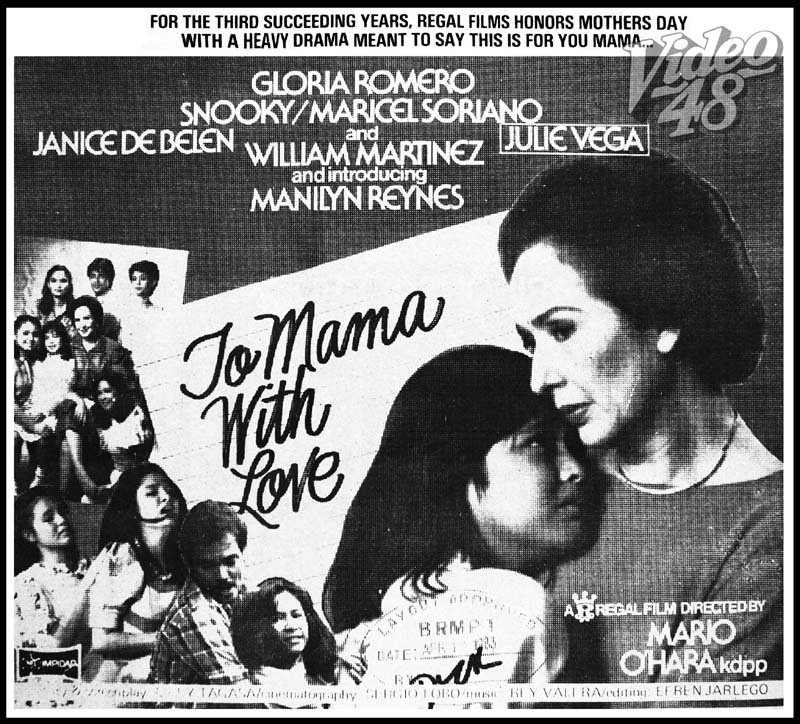
To Mama With Love (1983)- Stars Gloria Romero, Snooky Serna, Maricel Soriano, Janice de Belen, Julie Vega and William Martinez,/ Introducing Manilyn Reynes/ Directed by Mario O'Hara
Left- Condemned (1984)- Stars Nora Aunor, Gloria Romero, Gina Alajar, Rio Locsin and Dan Alvaro/ Directed by Mario O'Hara
Right- Bulaklak sa City Jail (1984)- Stars Nora Aunor, Gina Alajar, Celia Rodriguez, Perla Bautista, Maya Valdes, Zenaida Amador, Maritess Gutierrez, Shyr Valdez/ Directed by Mario O'Hara

Bagong Hari(1986)- Stars Dan Alvaro, Carmi Martin, Joel Torre, Robert Arevalo, Perla Bautista, Celso Ad Castillo and Elvira Manahan/ Directed by Mario O'Hara
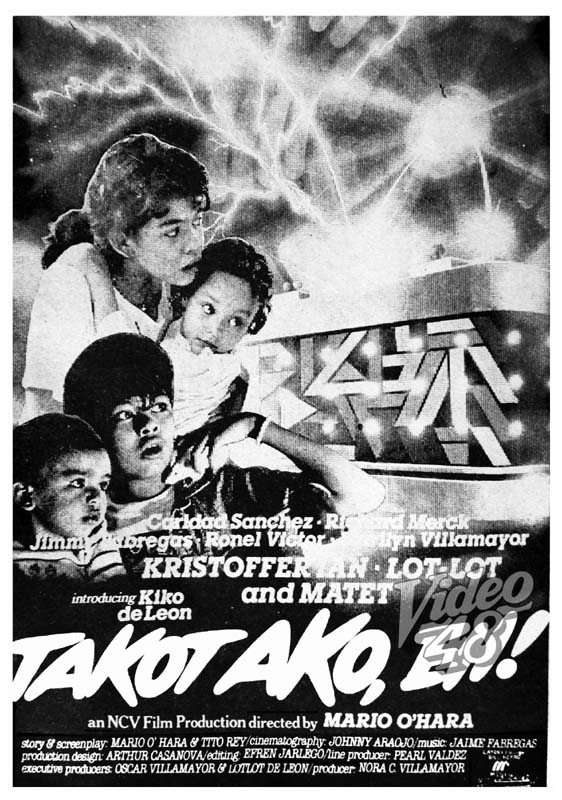
Right- Takot Ako, Eh! (1987)- Stars Kristoffer Ian, Lotlot, Matet, Caridad Sanchez, Richard Merck, Jimmy Fabregas, Ronel Victor, Marilyn Villamayor/ Directed by Mario O'Hara


Right- The Fatima Buen Story (1994)- Stars Kris Aquino, Zoren Legaspi, John Regala, Janice de Belen and Gina Pareno/ Directed by Mario O'Hara

Manananggal in Manila (1997)- Stars Tonton Gutierrez, Eric Fructuoso, Mike Magat, Aiza Seguerra and Alma Concepcion/ Directed by Mario O'Hara
Right- Sisa (1999)- Stars Gardo Versoza, Patrick De Guzman, Marcus Madrigal and Aya Medel/ with Evangeline Pascual/ Directed by Mario O'Hara
The Films of Mario O’Hara:
Ang Babae sa Bubungang Lata (1998)
Mama, Dito sa Aking Puso (1997)
Johnny Tinoso an the Proud Beauty (1994)
Takot Ako, Eh! (1987)
Halimaw (Episode: Banga) (1986)
Uhaw sa Pag-ibig (1983)
Bakit Bughaw ang Langit? (1981)
Mga Bilanggong Birhen (1977)
Thursday, June 14, 2012
35th GAWAD URIAN WINNERS (2012): MAJA SALVADOR, PAULO AVELINO AND "ANG SAYAW NG DALAWANG KALIWANG PAA" TOP WINNERS
June 13--- The best films of 2011 were honored at the 35th Gawad Urian Awards held at AFP theater in Camp Aguinaldo, Quezon City. Independent films, once again ruled this year's annual awards.
“Ang Sayaw ng Dalawang Kaliwang Paa” was adjudged the biggest winner with seven awards --- Best Picture, Best Director & Screenplay (Alvin Yapan), Best Actor (Paulo Avelino), Best Supporting Actress (Jean Garcia), Best Cinematography and Best Music.
Maja Salvador, on the other hand, won the Best Actress trophy for “Thelma.”
Complete list of winners:
Best Picture – Ang Sayaw ng Dalawang Kaliwang Paa
Best Actress – Maja Salvador (Thelma)
Best Actor – Paulo Avelino (Ang Sayaw ng Dalawang Kaliwang Paa)
Best Director – Alvin Yapan (Ang Sayaw ng Dalawang Kaliwang Paa)
Best Supporting Actress – Jean Garcia (Ang Sayaw ng Dalawang Kaliwang Paa)
Best Supporting Actor – Art AcuƱa (NiƱo)
Best Screenplay – Alvin Yapan (Ang Sayaw ng Dalawang Kaliwang Paa)
Best Cinematography – Arvin Viola (Ang Sayaw ng Dalawang Kaliwang Paa)
Best Production Design – Maulen Fadul (The Natural Phenomenon of Madness)
Best Editing – Lawrence Fajardo (Amok)
Best Music – Christine Muyco and Jema Pamintuan (Ang Sayaw ng Dalawang Kaliwang Paa)
Best Sound – Albert Michael Idioma and Addiss Tabong (Amok)
Best Documentary – Tundong Magiliw
Best Short Film – Sirip
Saturday, May 12, 2012
COMICS ARTIST TONY DE ZUĆIGA PASSES AWAY AT AGE 79
Called simply “Mang Tony” in comics circles, Zuniga, the first Filipino to do illustrations for Marvel and DC, suffered heart and kidney failure after being rushed to the Las Pinas Doctors Hospital at 1:30 a.m. He suffered a stroke on April 10 that paralyzed his left side. Fans and friends had earlier rallied to raise financial support for his hospitalization.
Formerly based in California, Mang Tony had decided to return to the country for good. In 2010, Jonah Hex was turned into a multi-million dollar Hollywood film starring Josh Brolin and Megan Fox.
“He loves the Philippines. He wants to retire here,” Tina, his wife of 11 years, said.
Mang Tony is survived by two sons from his first marriage and three daughters from his second.
The wake is open to the public on Saturday at the Funeraria Paz in Sucat.
Mang Tony’s remains will be cremated on Wednesday.
(Internet source)
Tony DeZuniga was an avid comics reader as a child, Tony's favorites included Jack Kirby and Alex Toth, and he loved Alex Raymond's Rip Kirby and Flash Gordon. His love for comics inspired him to do comics on his own. He began his career as a letterer when he was 16 for a weekly magazine where he met Alfredo Alcala and Nestor Redondo, artists who he counts as those who have inspired and encouraged him, and became his friends.
Maestro Federico / Nobela ni Mario Mijares Lopez/ Guhit ni Tony Zuniga/ Inilathala sa Marte Komiks, Blg. 1, Marso 5, 1952


He was soon given the chance to co-create a new character with writer John Albano, which eventually became Jonah Hex, one of the more enduring modern day characters in the DC Universe.
Source: The Philippine Comics Art Museum
De Zuniga did most of the movie poster ads and layouts of most of FPJ movies in the 1960s. These original movie posters/ads are well preserved and can be viewed upon request at the FPJ studio/compound at Del Monte ave, Quezon City.
Visit Tony De Zuniga Site


Sunday, April 22, 2012
POST-WAR TAGALOG MOVIES # 116: JAIME DE LA ROSA IN GERARDO DE LEON'S "PADRE BURGOS" (1949)
"Padre Burgos"
Premiere Productions, Inc.
Release Date: August 19- 28, 1949/ Life
Story Pedrito Reyes
Music Ariston Avelino
Cameraman Tommy Marcelino
Sound Demetrio Santos
Direction Gerardo de Leon
Cast Jaime de la Rosa, Efren Reyes, Virginia Montes, Amelita Sol, Frankie Grdon, Rino Bermudez, Oscar Keese, Conrado Conde, Dely Atay-Atayan, Kasupang, Francisco Conde, Francisco Cruz, Francisco Salcedo , Ermy Faustino, Bebong Osorio/ Introducing Johnny Reyes, Ester Buenaobra
Tuesday, April 3, 2012
DELIA RAZON AND MARIO MONTENEGRO IN "BANAL O MAKASALANAN ?" (1955)

"Banal O Makasalanan?" (1955) Stars Delia Razon, Mario Montenegro, Jose Cordova, Jose Vergara, Arturo Moran, Vicenta Advincula, Candida Balderama, Emelita Gitierrez and Jose Corazon de Jesus/ Directed by Susana C. de Guzman