“I would highly appreciate very much if you would at least acknowledge any materials used or at least ask for a permission first. Unless specified, all other materials are from the private collection of the blog owner. Thank you very much!”

Thursday, December 10, 2009

JOSE MIRANDA CRUZ' S "HIWAGA SA BAHAY NA BATO" (1962-63): LOCAL TV FIRST TELESERYE


"Hiwaga sa Bahay na Bato" (1962-63)/ Written and Directed by Jose Miranda Cruz/ Stars Dalton de Castro, Flora Cristobal, Eva Darren, Teddy Santos, Noel Nolasco, Estela Grande, Lita delos Reyes, Baby Bernardo, Ernesto Fajardo, Lina Chico and Ben David

We had our first television set sometime in 1961 or 62, a black-and-white RCA Victor (there's no color TV that time). I remember rotating the knob and tuning to Channel 3, watching old tagalog classics or Channel 7, with Uncle Bob’s Lucky 7 or reruns of Popeye animated cartoons. At this time, ABS-CBN Channel 3 premiered the first TV soap opera titled Hiwaga sa Bahay na Bato. It was aired from Monday to Saturday, 6:30 to 7:00 pm. That was in the latter part of 1962 and as a little boy, I was horrified seeing a monstrous and disfigured hunchback who lived beneath the stone house unknown to the owner, a filthy rich hacendero (played by Dalton de Castro). The hunchback was played by a radio talent, Ben David, who later became popular for being overacting or "OA." He was known portraying Judas or Hudas in Lenten plays and would burst with phrases like “O…Hindi…” or “ngingit ng mga pangit”

Ben David’s love interest was the very young Eva Darren, who up to now is appearing in TV soaps (now called telenovelas or teleseryes). I considered Darren one of the pioneers as far as TV soap operas are concerned.


Hiwaga
ran for about 4 to 5 months, from September 1962 to January 1963. It was one of the most successful early soap operas and made unheralded Director Jose Miranda Cruz a household name. Cruz went on to do more soap operas--- Prinsipeng Tulisan, Hanggang May Buhay, Larawan ng Pag-ibig, among others.


Courtesy of ABS-CBN

Tuesday, December 8, 2009

RICHARD ABELARDO: VISUAL EFFECTS MAN PAR EXCELLENCE


Left- "El Diablo" (1949)- Stars Leopoldo Salcedo, Rebecca Gonzales and Alfonso Carvajal/ Directed by Richard Abelardo


Right- "Mutya ng Pasig" (1950)- Stars Jose Padilla, Jr., Rebecca Gonzales, Teody Belarmino and Delia Razon/ Directed by Richard Abelardo


The changing colors of the painted bird and the princes turning into stone in Ibong Adarna, the gangplank over a deep chasm in Prinsesa Urduja, the castle in the air in Prinsesa Basahan, the transformation of Jaime de la Rosa in Taong Paniki, the parting of the Red Sea in Tungkod ni Moises, and the rampaging monster in Tuko sa Madre Kakaw- these are some of the cinematic memories created by Richard Abelardo.

Richard Abelardo - or Mang Kandong to his intimates - is a visual effects man par excellence who pioneered in special effects in the late thirties to fifties and taught the craft to his relatives (brother-in-law Teody Carmona, brother Bayani Abelardo and nephew Benjamin Resella), later important film artists in this field. Richard was born on September 29, 1902 in Bulacan. He learned scene design from his father, Juan Abelardo, the sculptor of the Biak na Bato monument and the foremost scenic artist of his time. His father painted the backdrops of zarzuelas and stage presentations at the Zorilla and other theaters. Early in his teens, he became scenic artist for a photo studio. He was commissioned to do the sets of a silent film being photographed by Ricardo Marcelino. However, the production wasn't finished, but this firmed his resolve to go to Hollywood. He learned to play the saxophone in first cousin Nicanor Abelardo's orchestra and applied as musician in a band playing aboard a President liner. In 1923, he jumped ship in San Francisco and motored to Hollywood.
Because of his-artistic abilities, he became a Union member and was allowed to work in a number of Hollywood productions at Warner Brothers and Universal. Among the films he worked on are The Cat and the Fiddle, Footlight Parade (1933), One Night of Love and Charlie Chaplin's Modern Times.
Because he wanted to see his ailing parents, he went back to Manila in 1936. He was invited by Vicente Salumbides to work on his Florante at Laura (1939). For this, he created the domed palaces of the fictitious royalty. He worked at X'OTIC when it opened in 1939 and was later summoned by his kababayan Dona Sisang to work on Ibong Adarna. He introduced the crane to local filmdom in the movie Palaris and background projection in Ibong Adarna. After the war, he opted to stay in the Philippines, working for Palaris Productions, Fernando Poe Sr.'s movie company. He directed his first film for him in 1948 with Malikmata with Jaime de la Rosa. Dona Sisang got him to direct Engkantada (1948) for LVN, about archaeologists stumbling upon the fabled kingdom of Mu ruled by centuries-old Lilia Dizon. As it was the last film of Lilian Velez, it was a big hit at the box-office. His career as film director already established, he, however, continued to do special effects. In 1950, he worked on Fritz Lang's An American Guerrilla in the Philippines.
He collaborated with Botong Francisco on two films which he directed: Haring Kobra (1950) and Higit sa Korona (1956). For the former, the duo created stupas and other Balinese structures to visualize a mythical country south of the Philippines. For the latter, they recreated the Egypt of the Pharoah. They also worked on the big LVN movies directed by Gregorio Fernandez and Lou Salvador Sr. For Doce Pares, they built a Moorish palace atop Intramuros. For Rodrigo de Villa and Prinsipe Tenoso, they had mattes of medieval kingdoms.


"Ang Nuno sa Punso" (1950)- Stars Mila del Sol, Jaime dela Rosa, Gil de Leon, Eusebio Gomez, Lila Luna/ Directed by Richard Abelardo

Richard also pioneered in prosthetics with the hairy face of Jaime de la Rosa in Taong Paniki (1952) and the giant reptile in Tuko sa Madre Kakaw (1959). For Big Shot, he developed a special kind of trick photography that would show dancers atop a ceiling. Aside from films, Richard designed the sets of some theatrical productions, especially those of Bert Avellana's Barangay Theater Guild.

Clearly, Richard Abelardo's achievements have enriched Philippine cinema. (Agustin Sotto/ Manunuri ng Pelikulang Pilipino)


Left- "Taong Paniki" (1952)- Stars Jaime dela Rosa, Delia Razon, Alfonso Carvajal, Frank Gordon, Rosa Aguirre, Gil de Leon/ Directed by Richard Abelardo

Right- "Anak ng Berdugo" (1955)- Stars Armando Goyena, Cecilia Lopez, Johnny Reyes, Oscar Keesee, Joseph de Cordova, Oscar Obligacion/ Directed by Richard Abelardo


Left- "Mariang Sinukuan" (1955)- Stars Mario Montenegro, Cecilia Lopez (first starring role), Milagros Naval/ Directed by Richard Abelardo

Right- "Higit sa Korona" (1956)- Stars Mario Montenegro, Delia Razon, Rosa Rosal/ Directed by Richard Abelardo


"Zarex" (1957)- Stars Carmencita Abad, Willie Sotelo, Jose Vergara, Alfonso Carvajal/ Directed by Richard Abelardo


"Tuko sa Madre Kakaw" (1959)- Stars Nita Javier, Willie Sotelo, Hector Reyes, Luz Valdez, Oscar Obligacion and Vic Diaz/ Directed by Richard Abelardo

"Lastik Man" (1965)- Stars Von Serna/ Directed by Richard Abelardo


"Miranda: Ang Lagalag na Sirena" (1966)- Stars Gloria Romero, Van de Leon, Bella Flores, Matimtiman Cruz, Menchu Morelli and Jing Abalos, Roger Calvin with Marifi (in the title role)/ Directed by Richard Abelardo

Sunday, December 6, 2009

JESUS "OG" RAMOS: RP CINEMA'S ANSWER TO TARZAN


"Og" (1952)- Stars Jesus Ramos and Leila Morena

Jesus “OG” Ramos, Mr. Philippines title holder in 1951, was probably local filmdom’s answer to Hollywood’s Tarzan. The title was his ticket to stardom and became one of the popular and big stars in Philippine cinema. Because of his muscular and physical built, he was launched by Premiere Productions, as “Og,” the local jungle hero, in 1952. Several hit sequels followed i.e. Og sa Maynila, Og sa Army, Lo’ Waist Gang at si Og sa Mindoro, among others. Ramos also appeared in non-Og movies, but he will be forever identified and remembered as “Og,” the jungle man.


"Og sa Army" (1954)- Stars Jesus Ramos, Rosita Noble, Lopito, Ramon D' Salva, Carol Varga, Vicente Liwanag/ Directed by Cesar Gallardo


Left- "Ang Sibat"(1956)- Stars Celia Fuentes, Jesus 'Og' Ramos, Amado Cortez/ Directed by Felix Villar

Right- "Kahariang Bato"aka- "Tagani" (1956)- Stars Cesar Ramirez, Alicia Vergel, Jesus 'Og' Ramos, Myrna Delgado,/ Directed by Rolf Bayer


Left- "Aliping Maharlika"(1957)- Stars Cesar Ramirez, Celia Fuentes, Jesus 'Og' Ramos, Ruben Rustia, Norma Reyes, Merle Tuazon/ Directed by Ramon Estella


Left- "Hindi Binyagan"(1958)- Stars Celia Fuentes, Jesus 'Og' Ramos, Tony Cruz, Jr., Norma Reyes, Jerry Lopez, Rosanna Recto, Jess Medina/ Directed by Felix Villar


Right- "Lo' Waist Gang at si Og sa Mindoro" (1958)- Stars Fernando Poe, Jr., Jesus 'Og' Ramos, Teresita Mendez, and the cast of Lo' Waist Gang/ Directed byPablo Santiago

Wednesday, December 2, 2009

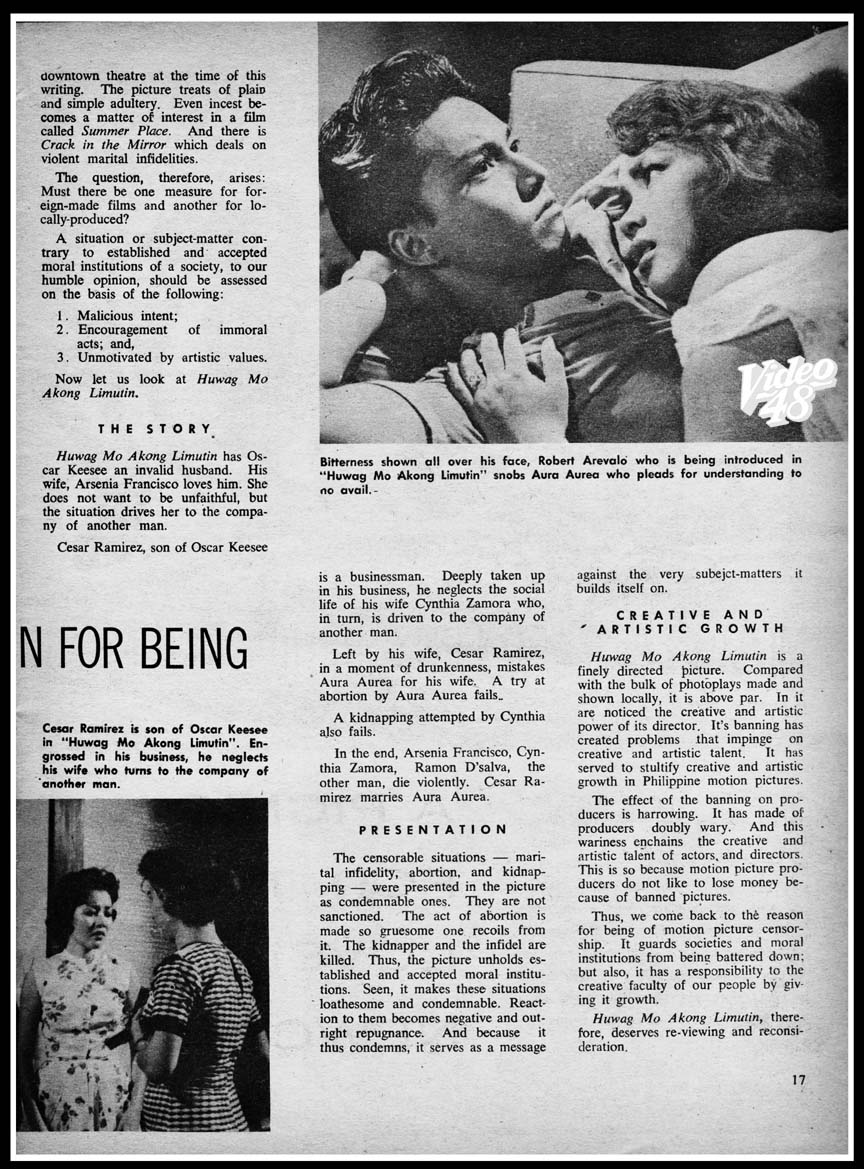
THE BANNING OF GERRY DE LEON'S "HUWAG MO AKONG LIMUTIN" (1960)


One of the scenes that sparked a controversy in 1960

Even the great Gerry De Leon was not spared by the Board of Censors. His first, Si Eva at si Adan (1954), a comedy on sexual identities, raised a furor with the Board of Censors. In 1960, Huwag Mo Akong Limutin, a drama on infidelity and impotence, was banned. The board cited three grounds: 1.marital infidelity; 2. abortion; and 3. kidnapping.

The controversy somehow lies on how one interpret the censorship guidelines--- the primary function of motion picture censorship is to guard against the exhibition of motion pictures that warp, corrode, or break down established and accepted moral codes and encourage or abet immoral acts. It exists primarily to protect moral institutions of our society. An article (below- click image to read) was written on the controversy and why the movie must be allowed to be exhibited.


The Plot:
Huwag Mo Akong Limutin has Oscar Keesee an invalid husband. His wife, Arsenia Francisco loves him. She does not want to be unfaithful, but the situation drives her to the company of another man.

Cesar Ramirez, son of Oscar Keesee, is a businessman. Deeply taken up in his business, he neglects the social life of his wife, Cynthia Zamora who, in turn, is driven to the company of another man. Left by his wife, Cesar Ramirez, in a moment of drunkenness, mistakes Aura Aurea for his wife. A try at abortion by Aura fails.
A kidnapping attempted by Cynthia also fails.

In the end, Arsenia Francisco, Cynthia Zamora, Ramon D’Salva, the other man, die violently. Cesar Ramirez marries Aura Aurea.
The censorable situations--- marital infidelity, abortion and kidnapping--- were presented in the picture as condemnable ones.

The movie, which was reconsidered and reviewed again, was later permitted to be shown with cuts. Manong Gerry cried foul--- his movie was severely mutilated by the censors.

The movie went on to win and romped away 8 Famas awards--- Best Picture; Best Director (Gerry de Leon); Best Supporting Actor (Oscar Keesee); Best Supporting Actress ( Arsenia Francisco); Best Cinematography (Ricardo Marcelino); Best Film Editing (Gerry de Leon); Best Musical Scoring (Tito Arevalo) and Best Sound (Demetrio de Santos).


Literary Song-Movie Magazine/ 1960
(click images to enlarge)

Monday, November 30, 2009

THE CONTROVERSY BEHIND "MERRILL'S MARAUDERS" (1962)


"Merrill's Marauders" (1962)- Stars Jeff Chandler, Pancho Magalona, Luz Valdez, Ty Hardin, Peter Brown, Will Hutchins, Andre Duggan, Claude Akins/ Directed by Samuel Fuller

-->Set in World War II Burma, Merrill’s Marauders is the true story of the fighting 5307th Composite Unit led by Brig. Gen. Frank Merrill (Jeff Chandler) and manned by Stock (Ty Hardin),Chowhound (Will Hutchins), Kolowicz (Claude Akins), Taggy (Pancho Magalona) and other young dogfaces who after a few weeks of basic training had the fate of the world loaded on their backs. Their mission was to drive a fatal wedge between an enemy link-up.

The movie became the subject of controversy in 1962. The cause: Filipino star Pancho Magalona was billed way down below the cast, and his voice was dubbed in a voice, diction and accent not his. However, when the movie was released locally, Pancho's name was billed next to the lead star and even Luz Valdez's name who only had a brief non-speaking role in the movie was way up. I'm pretty sure that Pancho's voice in the dvd version was his. See the film clips below---

(click images to enlarge)

Literary Song-Movie Magazine/ 1962


Courtesy of Warner Bros.

Sunday, November 29, 2009

"GILDA" (1955-56) AND "PASAN KO ANG DAIGDIG" (1987): KOMIKS SERIALS AND MOVIE ADAPTATIONS


Left- "Gilda" (1956)- Stars Lolita Rodriguez, Eddie Arenas, Rosa Mia, Maria Cristina, Eddie Garcia, Zeny Zabala/ Diected by Armando Garces

Right- "Pasan Ko ang Daigdig" (1987)- Stars Sharon Cuneta, Tonton Gutierrez, Mark Gil, Rey 'PJ' Abellana, Mario Montenegra, Princess Punzalan & Loretta Marquez/ Directed by Lino Brocka


When Pasan Ko ang Daigdig (starring Sharon Cuneta as Lupe) was shown in 1987, many thought it was a remake of the 1956 movie, Gilda (starring Lolita Rodriguez in the title role). Both were written by prolific writer Pablo S. Gomez. Though it differed in many ways, the two novels use the basic rag-to-riches plot and the only striking similarity is that the daughter (Gilda or Lupe), living in abject poverty, carries her crippled mother (aling Andang- played by Maria Cristina or aling Metring- Loretta Marquez) on her back as they beg for alms. Gilda was serialized in Pilipino Komiks in 1955-56 while Pasan ko ang Daigdig appeared on the pages of Aliwan Komiks in the 80s.

Here's the first installment of the komiks novel of "Gilda" and the opening film clip of the movie, "Pasan..."


Pilipino Komiks/ 1955-56/
Nobela ni Pablo S. Gomez/
Guhit ni Nestor Redondo


Unang Labas
(click images to enlarge)


Courtesy of Viva Films

Thursday, November 26, 2009

REMEMBERING JOHNNY DELGADO THROUGH HIS FILMS #3: "SALOME" (1981)


"Salome" (1981)- Stars Gina Alajar, Johnny Delgado and Dennis Roldan/ Directed by Laurice Guillen

My short tribute to honor the late actor Johnny Delgado, whom I considered as one of the finest actors in the movie industry, ends with Salome. Salome was one of the early successful collaboration efforts of husband-and-wife tandem of actor Johnny Delgado and director Laurice Guillen. It was hailed by critics and fans as one of the best movies of the decade. The movie went on to win the Urian Best Picture for that year including Best Director (Laurice Guillen); Best Actress (Gina Alajar); Best Editing (Efren Jarlego) and Best Screenplay (Ricky Lee). Johnny Delgado was nominated for both in the Famas and Urian Best Actor.

Salome is about the titular barrio girl (played with much versatility by a young Gina Alajar) who is married to a domineering man named Macario (Johnny Delgado). The film starts quite wonderfully with a pleasant montage of an early morning in a rural town, with roosters crowing, the bright sun glaring, and the waves steadily blanketing the glistening beach. Then comes Salome, dressed in white stained with red blood, running and screeching for help, finally saying that he has killed a man. The man (Dennis Roldan) is a mining engineer from
Manila who finds himself drawn to Salome. Guillen and her screenwriter Ricardo Lee basically unravels Salome's story through a series of flashbacks of the man's murder. Some have claimed that Salome is a Filipino version of Akira Kurosawa's Rashomon and they are probably right as Guillen and Lee follows the same style. Yet while Kurosawa was interested in the multi-faceted aspect of truth, Guillen is more interested in the powerplay of the genders.
(Source: : Oggs Cruz (oggsmoggs@yahoo.com) and visit his site here)

Here's a short film clip of Delgado's riveting and forceful portrayal as the oppressive and dominant husband of Salome.


Courtesy of Bancom Audiovision

Wednesday, November 25, 2009

REMEMBERING JOHNNY DELGADO THROUGH HIS FILMS #2: "MGA UOD AT ROSAS" (1982)


"Mga Uod at Rosas" (1982)- Stars Nora Aunor, Lorna Tolentino and Johnny Delgado/ Directed by Romy Suzara

An ambitious painter, Ding (Johnny Delgado), dreams of conquering the art world with his creations. Socorro (Nora Aunor) is a woman whose world is built around Ding--- his needs, his desires and his art. But all his time and attention are for Nina (Lorna Tolentino), a stunning advertising model who loves his money.

Whom must Ding choose: the woman he loves or the woman who loves him?


The movie, from the story and screenplay by Edgardo Reyes, was directed by Romy Suzara

Delgado in another restrained yet powerful performance as seen in this short movie clip---


Courtesy of Ian Films

LinkWithin

Blog Widget by LinkWithin