“I would highly appreciate very much if you would at least acknowledge any materials used or at least ask for a permission first. Unless specified, all other materials are from the private collection of the blog owner. Thank you very much!”

Monday, April 18, 2011

TEN "PINOY RELIGIOUS MOVIES" REVISITED, PART ONE

1. "Himala ng Birhen sa Antipolo" (LVN Pictures/ 1947)---


"Himala ng Birhen sa Antipolo' (1947)- Stars Rogelio dela Rosa, Rosa del Rosario, Tony Arnaldo, Rosa Rosal, Jaime Castellvi, Rosa Mia, Engracia Ibarra/ Directed by Susana C. de Guzman


Penned and directed by Susana C. de Guzman, Himala ng Birhen sa Antipolo, tells of Ramon (Rogelio de la Rosa), a graduating medical student, who fell in love with Pacing (Rosa del Rosario), a strong devotee of the Virgin of Antipolo. Though Ramon was not that religious and seldom goes to church, he courted Pacing, even going to church with her. Pacing gifted Ramon a framed image of the Virgin of Antipolo that would guide him, particularly with his studies. Ramon eventually finished his medical course and successfully passed the board. He became a topnotch surgeon.

The touching and beautiful song, "Tayo na sa Antipolo," is captured in the clip below---


Courtesy of LVN Pictures

Ramon’s father, Don Julian remarried a very young woman, Lolita (Rosa Rosal). Ramon felt that the woman was only after his father’s wealth. Lolita had eyes on Ramon but was having an affair with another man.

When Pacing’s mother got ill, Ramon was tapped to do the operation. But he was nowhere to be found and when he did the operation it was too late. Pacing’s mother died and was blamed for it. It was Lolita who orchestrated on why Ramon can’t be found.

Ramon later discovered Lolita’s immoral relationship but his father thought that it was his son who was having an affair with his wife. The incident made Ramon more depressed. He was devastated more when he received a letter informing him of the hospital’s decision to replace him. He turned his anger to the framed image of the Virgin of Antipolo and smashed it that resulted in an ugly cut in his palm.

Guilt dawned on Lolita and she bared the whole truth to her husband and to Pacing. As Pacing and his brother headed towards Ramon’s place, they figured in a vehicular accident. Pacing was badly injured and needed a surgical operation. Ramon was tasked to do the operation but it was impossible because of his injured hand. Pacing asked Ramon to seek guidance and forgiveness to the Virgin of Antipolo. A miracle occurred and his hand was healed. The final scenes on the movie can be viewed on the clip below---


Courtesy of LVN Pictures

2. "Kalbaryo ni Hesus" (Lebran/ 1952)---


I grew up watching
Kalbaryo ni Hesus in the 60s. I've seen it countless times and I still recalled Fernando Royo playing the role of Judas, Norma Blancaflor as the Blessed Mother Mary, Juan 'Johnny' Monteiro as Simon Bilibit and a foreign actor named Jennings Sturgeon as Jesus Christ. The movie, released in 1952, was an all-star cast that included among others, Carol Varga, Rita Rivera, Elvira Reyes, Ben Rubio, Teddy Benavides, Ramon D' Salva. The production design was done by National Artist Carlos 'Botong' Francisco and ably directed by Carlos Vander Tolosa.

3. "Banal O Makasalanan" (LVN Pictures/1955)---


"Banal O Makasalanan" (1955)- Stars Mario Montenegro, Delia Razon, Jose de Cordova, Jose Vergara, Arturo Moran, Vicenta Advincula, Candida Balderrama, Lita Gutierrez/ Directed by Susana C. De Guzman


Based on a radio serial by Susana C. de Guzman, Banal O Makasalanan (1955) tells of Salome (Delia Razon), a seductive and alluring daughter of Herodias and stepdaughter to King Herod (Joseph de Cordova), who discovers faith and Christianity through her love for a Roman centurion named Cornelius (Mario Montenegro).

A prophet named Juan Bautista (or John the Baptist) denounced Herodias marriage to Herod, her former husband’s brother, as a sin. Herodias bitterly resented Juan’s denunciation and promptly ordered Juan’s arrest and wanted him killed. Herod, fearing that John may be the messiah foretold by prophecy, would not do it. However, Herodias devised a plot and used Herod’s birthday celebration as an opportunity to carry the plan. She let Salome performed a dance that pleased Herod no end. He offered her anything she desired. Encouraged by Herodias, Salome asked Herod for the head of Juan on a platter. Reluctantly, Herod was compelled to obey her desires and ordered Juan to be beheaded (see clip below).


Courtesy of LVN Pictures

Salome had nightmares and sleepless nights because of that incident and Cornelius was there to comfort her. When news of a new prophet named Jesus gaining ground in the countryside, Cornelius was asked by Salome to investigate. Disguised as an ordinary man, he seek out the Man they called Jesus. Through his own eyes, he witnessed how Jesus performed miracles like using only a few loaves of bread and several fish to feed thousands of men, women and children. Cornelius told Salome about this and asked her to go with him and lead a new life. Salome declined the offer.

Salome asked Pontius Pilate’s help, Cornelius being one of Pilate’s men. With the help of Salome, Cornelius was arrested and because of the gravity of his crime he was sentenced to die. This was not what Salome wanted to happen and beg Pilate for mercy and to spare his loved one. Instead, Cornelius was given 20 whip lashes on the face that caused him to get blind. Disabled and incapacitated due to severe punishment, Salome asked Pilate for Cornelius’ freedom which Pilate acceded. She asked for Cornelius forgiveness and promised to take good care of him.

The movie ends at Golgota, where Salome with Cornelius, seek Jesus for repentance and atonement. A miracle happened as Cornelius' eyesight was restored (see clip below).


Courtesy of LVN Pictures

4. "Santa Lucia" (People's Pictures/ 1956)---


"Santa Lucia" (1956)- Stars Edna Luna (in the title role), Arsenia Francisco, Eddie Del Mar, Corazon Rivas, Jose Romulo, Carol Varga, Lauro Delgado, Ramon D' Salva, Ruben Rustia/ Directed by Teodorico C. Santos

In Sweden, December 13 is Luciadagen, or St. Lucia's Day. It is the beginning of their holiday season. St. Lucia was a young woman who lived in first century Rome. She was a Christian who would not give up her faith to marry an unbeliever. She was tortured and killed by order of the Roman Emperor, Diocletian.

Stories of her courage were brought to
Sweden by missionaries where she became known as the Lucia Bride. Old people said the Lucia Bride would go out early in the morning to bring food and drink to the poor. She wore white robes and a crown of light.

The story is acted out in Swedish homes with the oldest daughter playing the Lucia Bride. Early in the morning on December 13, she brings her parents a tray of sweet saffron buns and some coffee. She wears a white gown and a crown of greens, often made of holly. Her sisters and brothers dress in white and follow her. The girls carry lit candles and the boys wear tall, pointed caps and are called "star boys."


St. Lucia
is also honored in Sicily, where she was born. Christians there gather to celebrate her day with bonfires and torchlight parades...a fitting celebration since Lucia means "light."
Bill Petro, your friendly neighborhood historian www.billpetro.com/holidayhistory

5. "Sta. Rita de Casia (Patrona ng Imposible)" (Premiere/ 1958)---

Rosemarie Gil was only 16 years old when she was introduced as a saintly nun in her first movie, Sta. Rita de Casia in 1958.

For centuries St. Rita of Cascia (1381-1457) has been one of the most popular saints in the Catholic Church. She is known as the "Saint of the Impossible" because of the amazing answers to prayer, as well as the remarkable events of her own life.

St. Rita wanted to become a nun, but in obedience to her aged parents, she married. Her husband caused her much suffering, but she repaid his cruelty with prayer and kindness. In time he was converted, becoming considerate and God-fearing. But St. Rita was to undergo another great sorrow when her husband was murdered.

St. Rita then found that her two sons were entertaining thoughts of avenging their father's murder; she feared they would put their desires into effect in accord with the evil custom of the Vendetta. With heroic love for their souls, she begged God to take them from this life rather than allow them to commit this great sin. Not long afterward they both died, after preparing themselves to meet God.

Bereft of spouse and children, St. Rita devoted herself to prayer, penance and works of charity. After a time she applied for admittance to the Augustinian Convent in Cascia. She was refused, but after praying to her three special patron saints-St. John the Baptist, St. Augustine and St. Nicholas of Tolentino-she miraculously entered the convent and w as allowed to remain. This took place around the year of 1411

In the convent, St. Rita's life was marked by great charity and severe penances. Her prayers obtained for others remarkable cures, deliverance from the devil and other special favors from God.

So that she might share in the pain of His Crown of Thorns, Our Lord gave St.Rita a thorn wound in her forehead. It was very painful and gave off a disagreeable odor, yet she considered it a very great grace. She prayed, "O loving Jesus, increase my patience accordingly as my sufferings increase." The wound lasted the rest of her life.

St. Rita died on May 22, 1457 at the age of 76. People flocked to the convent to pay their last respects. Innumerable miracles took place through her intercession, and devotion to her spread far and wide.

St. Rita's body was preserved perfectly incorrupt for several centuries, and at times it gave off a sweet fragrance. At the beatification ceremony, the body of the Saint raised itself up and opened its eyes.

God has heard St. Rita's prayers for others on countless occasions, and certainly she will gladly intercede once again, on behalf of those who pray to her now-thus continuing to prove the truth of her great name: The Saint of the Impossible!

http://www.saint-rita.org/church/patronSaint/

6. "I Believe" (People's Pictures/1961)---

The angelic face of Viring was beautifully executed by talented artist and illustrator Elpidio Torres.


"I Believe" (1961)- Stars Zaldy Zshornack, Mina Aragon, Lauro Delgado, Carol Varga, Oscar Keesee, Teroy de Guzman/ Directed by Cesar Gallardo

When I saw Ishmael Bernal's Himala the first time in 1980, I was reminded of the 1960 movie I Believe. Both movies focused on the issues of one's true faith and devotion, their beliefs, infidelity, faithfullness, unfaithfullness... It involved all kinds of people, different characters--- the saints and the sinners, the believers and non-believers...

There's a strong similarity between the two main characters --- visionaries Elsa in Himala and Viring in I Believe--- both had visions of the Virgin Mary and subsequently their ability to cure and heal the sick.

I Believe was based from the popular 1961 komiks-serial novel by Mars Ravelo which was serialized in Hiwaga komiks. It was adapted into the movie that year with Zaldy Zshornack and newcomer Mina Aragon. Aragon (of the Salvador clan) was introduced in the movie portraying the challenging role of Viring.

I Believe- Serialized in Hiwaga Komiks/
Story by Mars Ravelo/ Penned by Elpidio Torres/ 1961

click images to enlarge


click images to enlarge


7. "Birhen sa Lupa" (VP Pictures/1965)---

"Birhen sa Lupa," was VP Pictures' Holy Week presentation in 1965. Rosemarie played the lead role whose faith "conquered greed...violence...hate...!"


"Birhen sa Lupa" (1965)- Stars Rosemarie, Liberty Ilagan, Dindo Fernando, Loretta Marquez, Rodolfo 'Boy' Garcia, Vic Pacia, Etang Discher, Mary Walter, Ely Roque/ Directed by Artemio Marquez

8. "Kaibigan Ko'ng Sto.Nino" (Lea Productions/ 1967)---
Roderick Paulate was only 5 or 6 years old and Gina Alajar (Regina Alatiit in real life) only eight years old, when they auditioned for Lea Productions' Kaibigan Ko’ng So.Nino (1967), The two bested some 300 aspirants getting the two of the four important roles at stake (Gina won the role of Oreng, while Roderick got the role of Bong.

When the movie Kaibigan Ko’ng Sto. Niño was first advertised and promoted in 1967, the name Mars Ravelo was being peddled to the moviegoers as the author of this popular komiks serial. Ravelo’s name was prominently placed above the title and I was duped to believing that it was really Ravelo’s masterpiece and was based from his story, till my blog-friend Jose Mari Lee took note of this in one of my blog posts---

Kaibigan Ko’ng Sto. Niño was actually written by A.S. Tenorio, but Mrs. Miling Blas, producer of Lea Poductions, struck a deal with Tenorio and Ravelo. Mrs. Blas had smash hit films after smash hit films – especially the ones based on Mars Ravelo's komiks serials. She wanted to use Ravelo's name as the author of the series and that was what happened. Tenorio agreed to receive the payment because he was supporting his family. What was so ridiculous was: the komiks readers who were also the moviegoers, knew who exactly wrote the story, and the film became a hit anyway, because it was already presold to the reading public.

Not a very good PR move for Lea Productions and the public felt cheated.
Lea had produced some of the best Filipino films, yet they had sort of tarnished their reputation because of this kafuffle.”


Pilipino Komiks/ 1967-68


(Click images to enlarge)


9. "Ang Gangster at ang Birhen" (Lea Productions/1971)---

Another for the Lenten season--- A 1971 komiks serial, Ang Gangster at ang Birhen by Ramon Marcelino. It was drawn by Mar Santana, one of our finest komiks illustrators, but an underrated one. It was serialized in Pilipino Komiks and adapted into the screen starring Dante Rivero and Hilda Koronel under Celso Ad. Castillo direction. Enjoy reading !!! kaya lang bitin!


"Ang Gangster at ang Birhen" (1972)- Stars Dante Rivero, Hilda Koronel, Alicia Lonzo, Matimtiman Cruz, Boy Alano, Edwin O'Hara, Nello Nayo, Mario Escudero, Jose Garcia/ Directed by Celso Ad. Castillo


click images to enlarge


Pilipino Komiks/ 1972

10. "Milagro sa Porta Vaga" (Fiesta Films/1982)---

In 1982, thirteen-year old Julie Vega, best remembered for her role in Mga Mata ni Angelita (1978), appeared in Milagro sa Porta Vaga, a true-to-life story of the miraculous Virgin of Our Lady of Solitude of Cavite City.


Nuestra Señora de la Soledad de Porta Vaga, also called "Reina de Cavite" and "La Virgen de la Soledad", is the patroness of Cavite City. The Blessed Virgin Mary is depicted as Our Lady of Sorrows. Mary, garbed in black and white attire, seems to be on her knees as she contemplates the Passion of Her Son, Jesus. Before her are the crown of thorns and the nails, the instrument of Christ's Crucifixion.(wikipedia)


Friday, April 1, 2011

"VIDEO 48" CITED IN "INSIDER PICKS: MANILA BY DAY" BOOK


In a Nutshell--- A daytime city guide bred by word of mouth, Insider Picks: Manila By Day isn't an attempt to cover all that the metro has to offer (especially since today’s café is tomorrow’s barber shop in these fickle parts). It is, rather, an inspired pursuit of premium alternatives: places and things well beyond the “same old, same old” whether they’re quirky holes-in-the-wall or old-timers with perks and goodies that many don’t know about. Insider Picks: Manila By Day is just that—insider secrets too delicious not to share!


to read, click image to enlarge


Video 48 Specialty: Old hard-to-find movies


Video killed the radio star, and pirated DVDs killed the video store. So why is Video 48 still around? Because it did something the chain stores failed to do. From the day it opened nearly 20 years ago, Video 48 offered something more than plain distribution. It’s called curation. The owner, Simon Santos, lives and breathes film, and has the most informed selection of local and Hollywood classics among all the video shops in the metro. Many a young filmmaker’s education was nurtured here, and the late greats like Lino Brocka and Chaning Carlos were regulars, as are today’s active directors and screenwriters...

My sincere thanks to the staff of Insider Picks: Manila By Day


Thursday, March 24, 2011

ELIZABETH TAYLOR, 1932-2011/ MY TOP 10 FAVORITE LIZ TAYLOR FILMS

Elizabeth Taylor, the actress who dazzled generations of moviegoers with her stunning beauty and whose name was synonymous with Hollywood glamour, died on Wednesday, March 23 (2011) in Los Angeles. She was 79.

A spokeswoman at Cedars-Sinai Medical Center said Ms. Taylor died at 1:28 a.m. Pacific time. Her publicist, Sally Morrison, said the cause was complications of congestive heart failure. Ms. Taylor had had a series of medical setbacks over the years and was hospitalized six weeks ago with heart problems.


In a world of flickering images, Elizabeth Taylor was a constant star. First appearing on screen at age 10, she grew up there, never passing through an awkward age. It was one quick leap from “National Velvet” to “A Place in the Sun” and from there to “Cleopatra,” as she was indelibly transformed from a vulnerable child actress into a voluptuous film queen.


In a career of some 70 years and more than 50 films, she won two Academy Awards as best actress, for her performances as a call girl in “Butterfield 8” (1960) and as the acid-tongued Martha in “Who’s Afraid of Virginia Woolf?” (1966). Mike Nichols, who directed her in “Virginia Woolf,” said he considered her “one of the greatest cinema actresses.”


When Ms. Taylor was honored in 1986 by the Film Society of Lincoln Center, Vincent Canby wrote in The New York Times, “More than anyone else I can think of, Elizabeth Taylor represents the complete movie phenomenon — what movies are as an art and an industry, and what they have meant to those of us who have grown up watching them in the dark.”
(Source: New York Times)

What's your favorite Elizabeth Taylor movies? My list---


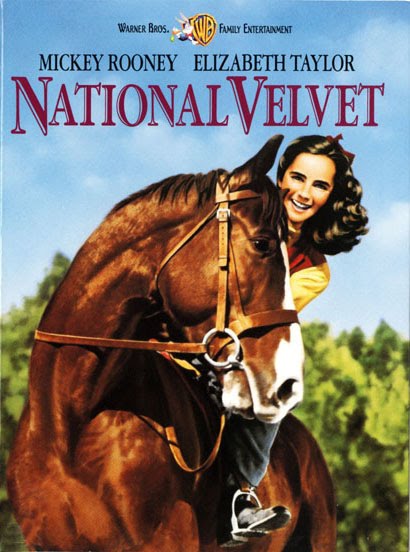
"National Velvet" (1945)

National Velvet tells the ever popular tale of two determined youths and one spirited thoroughbred that join forces to attain a seemingly impossible victory. Velvet Brown (Elizabeth Taylor) is a small girl with a big dream--- first prize in the renowned Grand National Steeplechase. With the aid of her shrewd pal (Mickey Rooney), she transforms “Pie”--- an unruly rogue of a horse which she won in a raffle--- into a viable contender. But Velvet soon learns that it will take more than hard work and dedication to achieve her goal. She will also need love, family, friendship, trust… and the help of that elusive and mysterious property that can only be described as the magical power of childhood dreams. (Product Description)


"Father of the Bride" (1950)

The Bride Gets the Thrills! Father Gets the Bills!

"I would like to say a few words about weddings," a weary man says from the middle of a muddle of rice and scattered bottles. What follows is a warm, witty look at what it means to be Father of the Bride.

Spencer Tracy is the father and Elizabeth Taylor the bride in this lively Vincente Minnelli-directed classic. Taylor is glowingly showcased - and reflected in three mirrors when first seen in a wedding gown. Tracy's performance captures every loving father's exasperations and joys as the day approaches. It also captured the fourth of his nine Best Actor Academy Award nominations. The film also earned nominations for Best Picture and Screenplay. Here comes the bride, there goes dad's wallet - and everyone's heart. What sparkling fun! (Product Description)


"A Place in the Sun" (1951)

George Stevens' stunning adaptation of Theodore Dreiser's An American Tragedy garnered six Academy Awards (including Best Director and Best Screenplay) and guaranteed immortality for screen lovers Montgomery Clift and Elizabeth Taylor. Clift stars as George Eastman, a poor young man determined to win a place in respectable society and the heart of a beautiful socialite (Elizabeth Taylor) . Shelley Winters plays the factory girl whose dark secret threatens Eastman's professional and romantic prospects. Consumed with fear and desire, Eastman is ultimately driven to a desperate act of passion that unravels his world forever. (Product Description)


"Giant" (1956)

Giant is a movie of huge scale and grandeur in which three generations of land-rich Texans love, swagger, connive and clash in a saga of family strife, racial bigotry and conflict between cattle barons and newly rich oil tycoons. It's also one of the most beloved works of director George Stevens, who won an Academy Award for this film, one of the 10 Oscar nominations the film earned. (Product Description)


"Raintree County" (1957)

Humongous MGM attempt to outdo Gone with the Wind, with (Montgomery) Clift as a small town Hoosier who makes the mistake of marrying Southern belle (Elizabeth) Taylor before the outbreak of the Civil War. Solid acting and memorable Johnny Green score help compensate for rambling, overlong script; Clift was disfigured in near fatal car accident during production, and his performance understandably suffers for it. (Leonard Maltin)


"Cat on a Hot Tin Roof" (1958)

Nothing is ever what it seems in Big Daddy's house. The rich old man believes he's in perfect health, but the reality is he's dying of cancer. And then there's Brick (Paul Newman), Big Daddy's favorite son, whose drunken abusiveness threatens not only his inheritance, but also his marriage to the sensous Maggie (Elizabeth Taylor). So when Big Daddy finally learns the truth about his illness and discovers the shocking secret behind Brick's mysterious behavior, he is forced to give his self-pitying son the toughest advice he can: "I've got the guts to die, boy...have you got the guts to live?" (Product Description)


"Suddenly, Last Summer" (1959)

Elizabeth Taylor and Katherine Hepburn each received 1960 Oscar nominations for Best Actress in this gripping adaptation of the Tennessee Williams play. Beautiful Catherine Holly (Taylor) is committed to a mental institution after witnessing the horrible death of her cousin at the hands of cannibals. Catherine's aunt, Violet Venable (Hepburn), tries to influence Dr. Cukrowicz (Montgomery Clift), a young neurosurgeon, to surgically end Catherine's haunting hallucinations. By utilizing injections of sodium pentothal, Dr. Cukrowicz discovers that Catherine's delusions are in fact true. He then must confront Violet about her own involvement in her son's violent death. (Product Description)


"Butterfield 8" (1960)

Lots Of Men Knew Her Number. No One Knew Her Heart.

Gloria Wondrous awakens in a luxurious bedroom that's not hers. She swallows a jolt of distilled courage, tosses aside $250 left by an admirer, leaves a scornful reply in lipstick on the mirror, dials her service for messages and slips into a mink coat she finds in the closet. The day and the movie are off to a roaring start.

Moviegoers and Hollywood left a message of "Hurrah!" for Elizabeth Taylor and Butterfield 8. Audiences made the film, co-starring Laurence Harvey and Eddie Fisher as a married lover and platonic friend who matter to Gloria, a box-office hit. And Taylor won her first Best Actress Academy Award as the call girl whose life comes with a complete set of emotional baggage. For a glossy, good time, don't call. Watch. (Product Description)

"Who's Afraid of Virginia Woolf?" (1966)

Elizabeth Taylor and Richard Burton are ideal as malevolent couple Martha and George in first-time film director Mike Nichols's searing film of Edward Albee's groundbreaking Who's Afraid Of Virginia Woolf?. Taylor won her second Academy Award (and New York Film Critics, National Board of Review and British Film Academy Best Actress Awards). Burton matches her as her emotionally spent spouse. George Segal and Best Supporting Actress Oscar winner Sandy Dennis score as another couple straying into their destructive path. The movie won a total of five Academy Awards and remains after four decades a taboo-toppling landmark. (Product Description)


"The Taming of the Shrew" (1967)

Elizabeth Taylor and Richard Burton sparkle and amuse as Katharina and Petruchio in William Shakespeare's comic look at male chauvinism and women's lib in the 16th century. Petruchio, a poverty-stricken gentleman from Verona, journeys to Padua in search of a wealthy wife. There he encounters the fiery Katharina, a self-willed shrew who leads Petruchio on a merry chase before he successfully circumvents her attempts to avoid marriage. Their honeymoon becomes a humorous battle of wit and insult with Kate as determined to maintain her independence as Petruchio is to "tame" her. When the embattled couple returns to Padua, Kate helps Petruchio win a wager that he is the most obedient of wives. But in reality, the shrewish Kate has found a more effective way to dominate her mate. (Product Description)

A MESSAGE FROM RHEA SANTOS


Rhea Santos, an award-winning broadcast journalist, host and newscaster of GMA Network Channel 7, visited Video 48 last March 3 for the taping of her weekly program, “Tunay na Buhay.” The shop was used as a backdrop for the episode on the life of Gino Antonio, a popular bold star of the 80s.

I was touched by the very warm message of Ms. Santos when my staff asked the pretty host for an autograph.


Rhea Santos

LinkWithin

Blog Widget by LinkWithin